

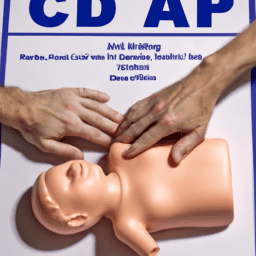
Cardiopulmonary resuscitation (CPR) is a lifesaving technique that can be used to restore circulation and breathing in someone who is not breathing or whose heart has stopped. It is recommended for anyone who is not breathing or whose heart has stopped. Knowing the correct technique for providing CPR on a child or adult is essential for providing the best possible care.
Understanding CPR Technique
CPR is a combination of chest compressions and rescue breathing. The goal is to restore normal circulation of oxygen-rich blood to the brain and heart. Chest compressions are used to keep the blood circulating and rescue breathing is used to get oxygen into the lungs. The ratio of chest compressions to rescue breaths is 30:2 for adults and children over the age of 8, and 15:2 for children under the age of 8.
The compression rate should be 100-120 compressions per minute, with each compression being roughly two inches deep. The rescuer should also take care to avoid pushing too hard and causing injury to the patient. It is important to be aware of the pulse and breathing of the patient and to stop CPR if either returns.
Providing CPR on a Child or Adult
When providing CPR on a child or adult, the first step is to check the unconscious person for signs of life, such as breathing or a pulse. If there are no signs of life, then CPR should be started immediately.
For an adult, CPR should begin with 30 chest compressions followed by two rescue breaths. The chest compressions should be performed at a rate of 100-120 compressions per minute and each compression should be roughly two inches deep. The rescuer should take care to avoid pushing too hard and causing injury to the patient. After the 30 chest compressions, the rescuer should give two rescue breaths, taking care to ensure that the airway is open and that the breaths are being delivered properly. This cycle should be repeated until help arrives or the patient regains consciousness.
For a child, the technique is slightly different. The chest compressions should be performed at a rate of 100-120 compressions per minute, but each compression should only be approximately one and a half inches deep. The ratio of chest compressions to rescue breaths is 15:2, so after 15 chest compressions, two rescue breaths should be given. The cycle should be repeated until help arrives or the patient regains consciousness.
CPR is an essential lifesaving technique that can be used to restore circulation and breathing in someone who is not breathing or whose heart has stopped.
Cardiopulmonary resuscitation, more commonly known as CPR, is a lifesaving technique used to maintain respiration and circulation of oxygenated blood to the brain and heart when breathing and/or heartbeat has stopped due to cardiac arrest. Knowing how to perform CPR correctly on an adult or a child is an essential skill and could be the difference between life and death for someone who is experiencing cardiac arrest.
The technique for providing CPR on an adult is slightly different than that for a child. For an adult, the correct technique involves pushing down hard at the center of the chest at a rate of 100 to 120 chest compressions per minute with both hands. The hands should be positioned the width of two fingers above the breastbone and compressed to at least two inches deep. After every 30 chest compressions, give two rescue breaths. Provide the rescue breaths by tilting the head back and lifting the chin. Then, pinch the nose and make a seal over the person’s mouth while gently blowing in air for one second.
When providing CPR on a child, use one hand to perform chest compressions at a rate of 100 to 120 per minute, pressing down 1.5 to two inches deep. Provide two rescue breaths, as previously mentioned.
It is important to note that if the heart stops due to an electric shock, do not perform CPR unless the person is unresponsive and has stopped breathing. Furthermore, after five minutes of performing CPR, switch to the next responder and have them continue to perform the chest compressions until medical help arrives.
In conclusion, while CPR can be intimidating, it is a critical life-saving skill to have in order to maintain circulation and respiration in the event of a cardiac arrest. Knowing the correct CPR technique for both adults and children can save somebody’s life in such a critical situation.
