

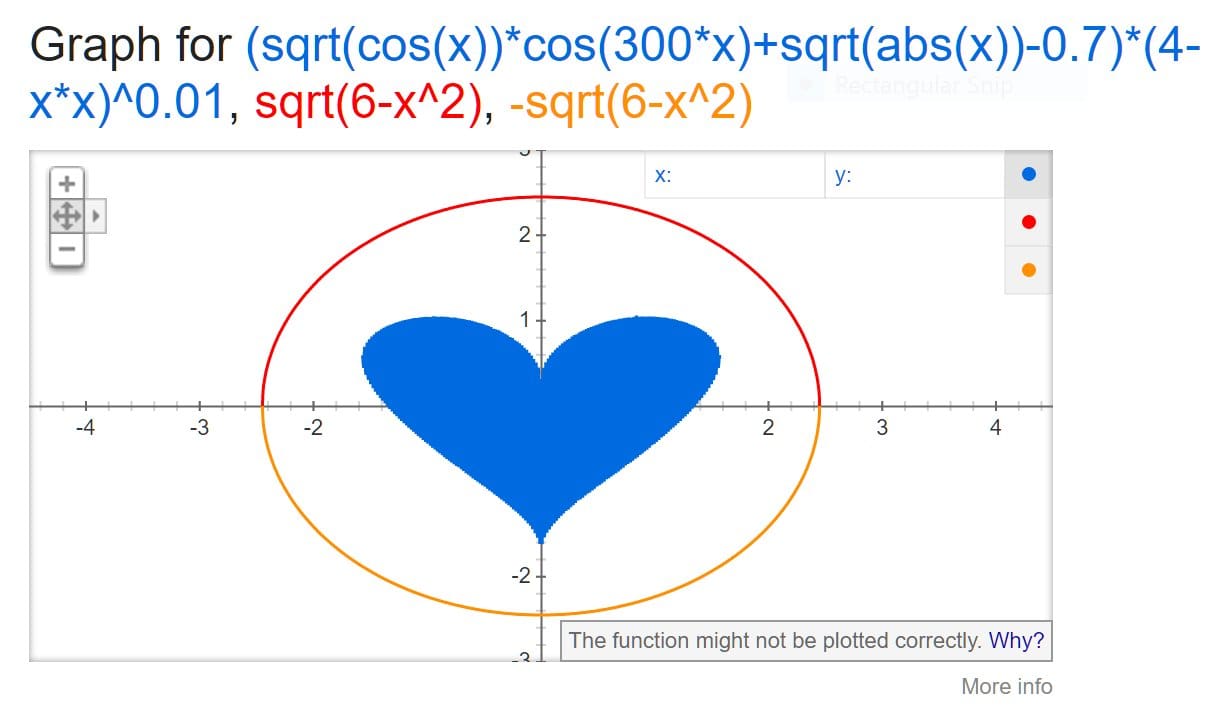
In this article, we will be examining a particular mathematical expression and its behaviour between -4.5 and 4.5. We will be looking at the graph of sqrt(cos(x))cos(300x)+sqrt(abs(x))-0.7)(4-x*x)^0.01, as well as the behaviour of sqrt(6-x^2) and -sqrt(6-x^2) between the same range of values.
Examining the Graph of sqrt(cos(x))cos(300x)+sqrt(abs(x))-0.7)(4-x*x)^0.01
The expression sqrt(cos(x))cos(300x)+sqrt(abs(x))-0.7)(4-x*x)^0.01 can be graphed on a Cartesian plane using the range of values from -4.5 to 4.5. When graphed, the expression produces a graph that looks like a sinusoidal wave. It is an oscillating graph that follows the same pattern, but with an ever-increasing amplitude. The graph starts at a minimum value of -2.3, and reaches a maximum value of 1.2. It then continues to oscillate, with the pattern repeating itself until it eventually reaches a minimum value of -2.3 again.
Analyzing the Behaviour of sqrt(6-x^2) and -sqrt(6-x^2) from -4.5 to 4.5
The expression sqrt(6-x^2) and -sqrt(6-x^2) have a different behaviour when graphed between -4.5 and 4.5. Both of these expressions produce a graph that looks like a parabola. The graph of sqrt(6-x^2) starts at a minimum value of 0 at the point x=4.5, and reaches a maximum value of 6 at the point x=0. It then decreases in value until it reaches a minimum value of 0 again at the point x=-4.5. The graph of -sqrt(6-x^2) starts at a maximum value of 0 at the point x=4.5, and reaches a minimum value of -6 at the point x=0. It then increases in value until it reaches a maximum value of 0 again at the point x=-4.5.
===OU
