

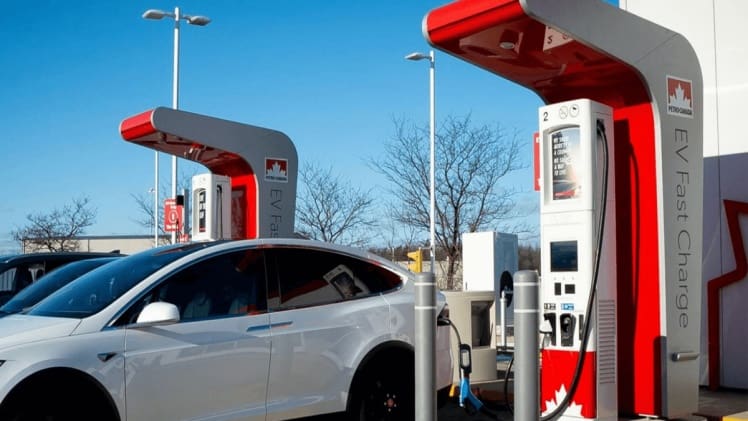
Canada registered 90,000+ new electric vehicles in 2022, which is more than 7.5% of all newly registered cars that year. There has been a steady increase in EV purchases, and Canada is expected to register over 190,000 by 2027.
This growth in numbers necessitates the installment of more EV charging stations in Canada to enhance the infrastructure and give peace of mind to EV owners. Hence, the government and private companies are continuously setting up new charging stations with support from suppliers like Electrly.
As an EV driver or potential owner, you may be wondering, are these charging stations free to use? The answer is Some. While free charging stations exist, many will require you to pay a small fee. Keep reading this guide for more about free EV charging stations.
Overview of EV Charging Stations in Canada
In the last two years, Canada has seen the number of public charging stations grow by 39% to about 20K across the country. Thanks to Tesla and EV charging products manufacturer, Electrly, for making this possible.
With Electrly, you can order as few as single units of EV portable chargers, fast chargers, level 1 & 2 chargers, and more. They have charging options for residential, commercial, and industrial settings and allow customization through the addition of logos, custom colors, etc., to suit your requirements.
Types of EV Charging Stations in Canada
There are three main types of electric vehicle charging stations in Canada, Level 1, Level 2, and Level 3. While they have different voltage and charging speeds, how fast your vehicle charges also depend on the car battery’s size.
-
Level 1
Level 1 Chargers are commonly for private use in the homes of EV owners and are the majority. However, they are the slowest and add about 7-9 km (4.5-5.5 miles) per hour. At this rate, it takes between 40-50 hours to charge an electric car battery from empty to full.
-
Level 2
Level 2 chargers are mainly for public use and compose over 12000 of the 20000 publicly available ones. They can be found in malls, gas stations, business centers, and other public spaces. Level 2 chargers are considerably faster and can charge from empty to full in 4-10 hours. They add about 20-130 km (12.5-81 miles) per hour.
-
Level 3
Also known as DC fast chargers, level 3 chargers are the quickest and can charge an EV from empty to full in 30-45 minutes. They add between 5-32 km (3-20 miles) per minute and are mainly used for commercial purposes. Level 3 chargers are the fewest and are mostly found in public places.
For whichever charging unit you are interested in setting up, choose Electrly. They have a transparent way of doing business, from ordering, to delivery, to the safe installation of EV charging stations. What’s more, you get the most competitive and discounted prices for buying EV chargers in bulk.
Cost of Charging an EV in Canada
The cost of charging is mainly determined by the type of charger at the station. For level 2 chargers, you will pay between $1.00 per hour and $2.50 per charge. Level 3 chargers are billed by the minute and cost an average of $15-$20 per hour. Home charging is the cheapest and costs about $280 in electricity costs per year.
Free EV Charging Stations in Canada
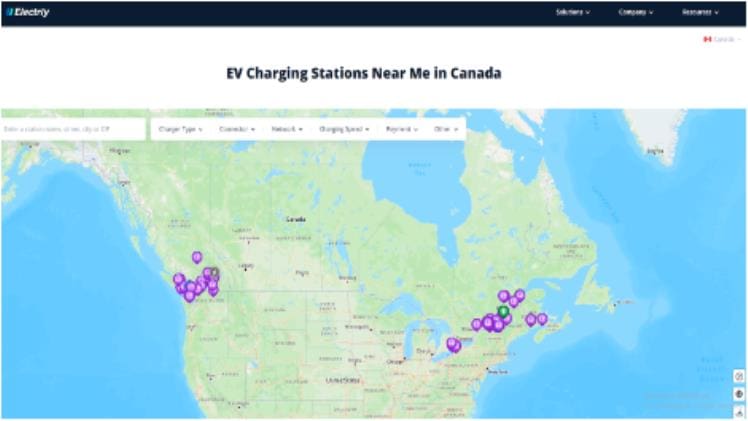
Free EV charging refers to EV charging stations that are free to use. Typically, free chargers are level 2 chargers, but there are also a few DC fast chargers. You can use the Electrly EV charger locator on their website to locate these stations. Some of this software enables you to filter free charging stations.
Most organizations offering free charging are automakers who use it as an incentive for selling their EV cars. For example, Audi provides four years/1400 kWh DC fast charging sessions at Canadian Electrify stations. Others include Lucid, Mazda, Porsche, and Volkswagen. However, these free sessions are limited and run out after 2-3 years.
Other providers of free EV charging include local governments, private companies, and nonprofit programs like Adopt a Charger. Businesses, in particular, offer employees charging points as a perk. Some EV charging providers like Volta also provide a few minutes of free charging.
Unfortunately, compared to the number of EV drivers, free EV chargers in public places are few and far apart.
Factors Influencing the Availability of Free Charging Stations
A level 2 EV charger costs between $1200 and $6000, depending on the model and power. On the other hand, a level 3 charger goes for between $30000 to $80000.
However, since installation involves electrical and construction work, the total cost can increase by another $1000 to $5000. Maintenance will cost around $400 per year per charger.
The company you contract also plays a key role in the total cost. Thus, I recommend using Electrly for the most pocket-friendly EV charger setup. Electrly is a top-flight EV charging stations provider that offers services across Canada and North America. It offers solutions for both home and commercial use and can set up all types of chargers.
With the increase of EV users, multiple companies offer EV charger production services, but Electrly stands out majestically. Here’s why:
- It’s affordable.
- Trains you to use the charger.
- Smartphone charger control.
- Supports level 2 and 3/DC fast chargers.
- High safety standards.
- Certified technicians.
- Code-compliant wiring.
Government Rebates for EV Chargers Installation
Fortunately, the government offers rebates for installing EV chargers in public places, workplaces, and multi-family homes. For a level 2 charger, you will receive a refund of 50% of the total project cost up to $5000. For a level 3 charger, you receive a maximum of $100,000.
Anyone can apply for these government rebates, but they are offered on a competitive basis. Factors such as when you apply, and your location are taken into account when considering your application. Your charger must also be approved for use in Canada and equipped with an SAE J1772 connector, except for Tesla. Local governments also offer rebates.
Private Sector Incentives
EV automakers and EV charger sellers offer the most incentives for EV installation. For example, Chevrolet pays for the installation of a level 2 charger for anyone who purchases the 2022 or 2023 Chevrolet Bolt. Cadillac also has a similar offer, but the client has to buy their own charger. Thus, before purchasing an EV or EV charger, inquire about their charger incentives.
Future of EV Charging in Canada
EV ownership in Canada is expected to grow exponentially, with annual unit sales hitting 194k plus by 2027. The EV market is projected to show an annual growth rate of 20.64% between 2023 and 2027. Tesla will continue having the lion’s share of the market, but more than ten other automakers are selling EVs in Canada.
Regarding EV charging, the technology and infrastructure will keep up with EV growth. The demand for bigger batteries and longer ranges necessitates faster chargers.
Thus, the EV charging solutions market is projected to grow at an annual rate of 30.6% from 2022 to 2030. EV drivers will have faster chargers, which will mean less charging time.
As a result of this growth, free EV chargers will increase considerably. More nonprofit organizations and business centers are steadily installing free charging points. The Canadian federal and local governments are also allocating funds to construct free EV charging stations.
Summary
As EVs increase, they will trigger the construction of new charging stations. These will include a percentage of free EV chargers. This increase in EVs and charging stations is an advantage in the fight to reduce our carbon footprint. The electrification of our roads promotes sustainable and environmentally friendly transportation.
That said, free EV stations in Canada are insufficient to cater to the growing number of EV drivers. Unless there is a free charging point near you, you will often have to charge at home or part with a small sum at pay to use charging points. Free EV stations are convenient but sometimes limit how long or how much you can charge.
